 What's in a name?
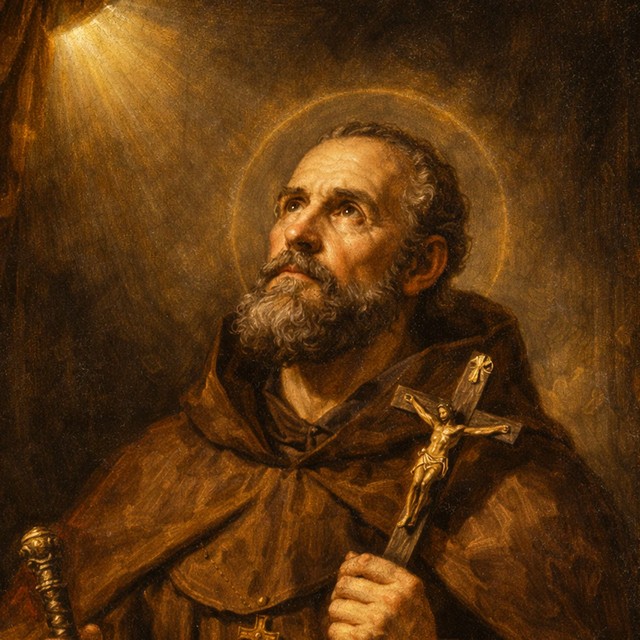
This year, we begin the 450th year celebration of the birth of Marcos Rey, son of Juan Rey, a native of Spain. His mother was Genevieve Rosemberger. It’s well known that he was born in Sigmaringen [now in Germany] into a Flemish family, and that he received a solid Christian education before becoming a compassionate and charitable lawyer. Later, he became a Capuchin friar named Br. Fidelis. He died a martyr’s death during the Wars of Religion in 1622 at 45, but his martyrdom, on April 24th, would lead to his being named the Patron of the Vatican Congregation for the Propagation of the Faith [now called the “Evangelization of Peoples”].
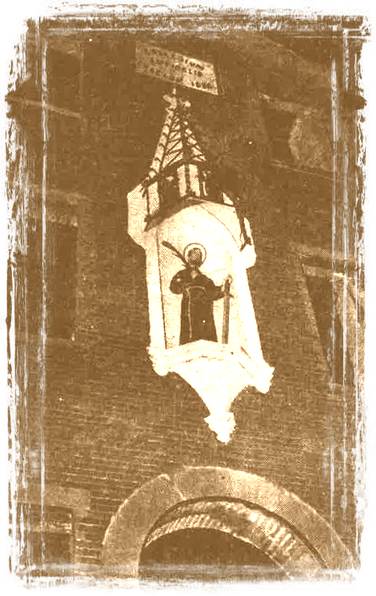 A few centuries later in 1873, Pope Pius IX issued a decree authorizing the Capuchin Order to establish preparatory seminaries. It was a major move from the Vatican, but it was also the time when German Capuchins had begun moving out of Europe to propagate the Americas. And so what? Well . . .
In October of that same year, our Capuchin confreres Hyacinth Epp and two companions arrived from Bavaria and found a welcome in the Diocese of Pittsburgh, PA. Within months, the friars gathered a group of boys at St Augustine's and gave them fundamental lessons in English (for the young German immigrants) and in Latin. At St. Augustine’s Friary, the boys were only day students. It became obvious to them that the present arrangement was a poor substitute for the ideal set up by Pius IX. The friars realized that they had to find a different place for a seminary and a novitiate.
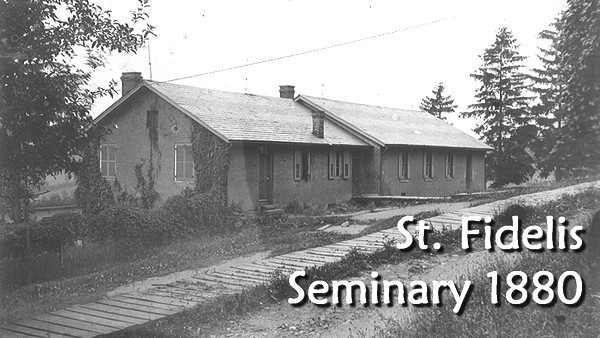
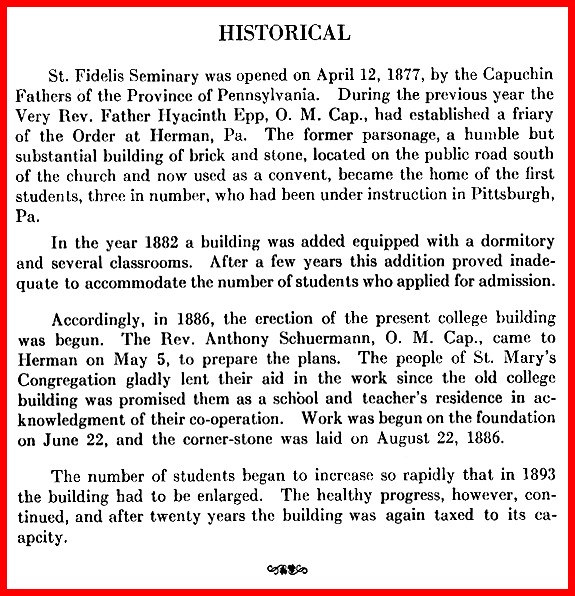 Early in 1876, approaching the diocesan bishop, Vincentian Michael Domenec, the friars presented their problem. The bishop generously offered a choice between a parish in Indiana County and one in Butler County. The Capuchins chose Saint Mary's in Butler County as the more desirable location for the Preparatory School and Seminary. Hyacinth installed its first Capuchin pastor there on May 8, 1876. Beginning at once to build a monastery next to the Church of St. Mary's, they prepared the parish house for a seminary building which was to accommodate 20 boys. On April 18, 1877 [an incorrect date is given in the history box published in 1927], they brought three students from St. Augustine's in Pittsburgh and began their venture.
Aside from the fact that the school students arrived a week before St. Fidelis’ feast day – aside from the fact that 1877 was the 300th Anniversary of Fidelis of Sigmaringen’s birth – and even aside from the fact that Bavarian friar Fidelis Weinschenk [+1899] was sent to be among the first teachers assigned there, it was the consensus among the Province’s leaders to name the new school St. Fidelis.
Besides, they would be celebrating the feast day, like us, on April 24th.
St. Fidelis Seminary would go on to nurture (and “propagate”) the faith of young men for 100 years
and to nurture the Capuchin vocations of hundreds of them. What a patron!